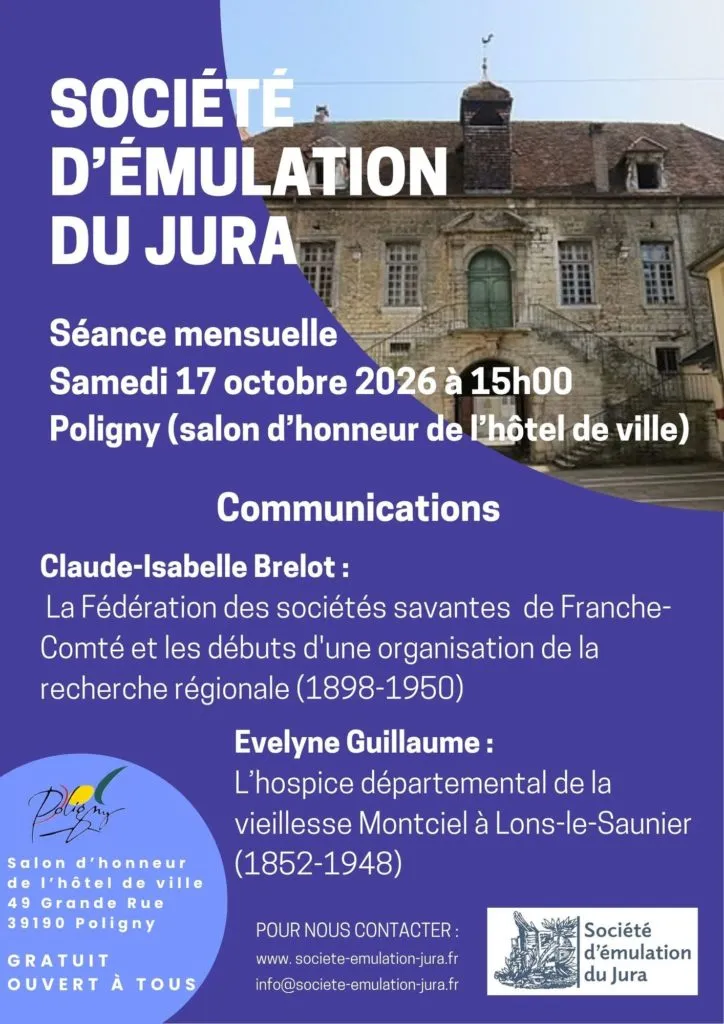
In Poligny, a talk traces the ambitions and difficulties of the Fédération des sociétés savantes de Franche-Comté, founded in 1898.
About this event in the Jura in Poligny
Organising regional research : a historical ambition
At the Salon d’Honneur in Poligny town hall, the talk “The Fédération des sociétés savantes de Franche-Comté and the beginnings of organised regional research (1898–1950)” looks back at the ambitions and difficulties of this institution.
Founded in 1898 at the initiative of Jules Gauthier, archivist for Doubs, the Federation did not confine itself to scholarly socialising. The gourmet banquets at its annual congresses often attracted mockery, but they do not sum up its work. From the outset, its programme had a broader ambition: to organise historical and archaeological research at a regional level.
A programme that proved difficult to put into practice
The implementation of this project ran up against a lack of resources that the Federation had failed to secure for itself. The reasons for this situation remain poorly understood: the Federation’s archives have not been preserved. Parochialism and individualism probably prevailed, though this explanation therefore remains cautiously presented.
Frustration and discouragement were evident as early as 1909. It was not until after the Second World War that the Bulletin de la Fédération began to put the programme into practice, and not without difficulty.
Others take up the cause of research in Franche-Comté
Other players then took their place in this landscape. The Université de Besançon revived the tradition of courses on the history of Franche-Comté, while the Institut d’études comtoises et jurassiennes launched the Bibliographie comtoise. Private initiatives also helped fill some gaps.
The departmental archive services, for their part, prepared biographical dictionaries published by local private publishers. In the late 1970s, administrative decentralisation primarily reinforced the role of the State and the Regions.
An institution that remains fragile
Despite the revival of the association and its regular congresses in 2002, the Federation remains institutionally weak. Extending beyond the period announced in the title, this history thus leads to an open question: what will happen in the years ahead?